SAN monitoring
SAN monitoring covers Fibre Channel switches, their ports and inter-switch links, and the storage arrays connected to them. XorMon, open source under GPL v3, monitors Broadcom (Brocade), Cisco MDS and Nexus, and QLogic switches on this page, and storage arrays on the storage monitoring page, graphing throughput, errors, buffer credits and SFP power (Brocade).
What is SAN monitoring?
SAN monitoring tracks the health, performance and errors of a storage area network, from Fibre Channel switch ports and inter-switch links up to the storage arrays attached to them.
A SAN carries the block storage traffic between servers and storage arrays through Fibre Channel switches. Monitoring it means graphing the traffic and the error counters of every port, and spotting hardware or logical problems on ports and switches before applications slow down. XorMon covers the switch side on this page and the array side on the storage monitoring page. LPAR2RRD and STOR2RRD are legacy tools. XorMon is their full-stack successor, and all new development goes into XorMon. Per the Migration page, LPAR2RRD and STOR2RRD can run alongside XorMon on the same devices during the move, device definitions can be imported, and the XorMon license is covered, at no extra fee, by the existing support contract of enterprise edition customers of those tools for the same environment size. Performance history is not migrated.
Sources: XorMon storage monitoring, updated 2026-11-02, About Xorux, and Migration, updated 2026-07-26.
Which SAN monitoring software supports Brocade, Cisco and QLogic switches?
XorMon supports Broadcom (Brocade) switches and their re-brands, Brocade SANnav v2, Cisco MDS, Cisco Nexus and QLogic switches. It collects data through the Brocade REST API, SNMP (Brocade and Cisco) or SANnav v2.
Brocade virtual fabrics and Cisco VSANs are supported. Each Brocade virtual switch is configured and shown as a separate switch, and its data is available through SNMPv3 only. XorMon is free to download and to run in production, with no registration and no time limit; the free edition is limited to 4 SAN switches, and the Enterprise edition, which comes with a support contract, removes all device and feature limits (see the edition comparison).
Sources: Virtual switch, updated 2026-05-04, Pricing (FAQ), and Support and editions.
Which SAN metrics does XorMon collect, and how often?
XorMon graphs data throughput, frame throughput, CRC and other port errors, CPU and memory usage, buffer credits and SFP power. SAN switches polled over SNMP are sampled and collected every 5 minutes.
Port errors include CRC, encoding, enc out, disc c3 frames, link fail, loss sync and PCS. Buffer credits are shown as the percentage of time a port could not transmit frames; 100% means the port could send nothing in that period. SFP input and output power, in dBm, is available for Brocade switches only. Graphs are aggregated per port, per switch, per fabric, for all switches together and per ISL (inter-switch link). SAN data is kept as 5-minute averages for 3 months, hourly averages for 6 months, 6-hour averages for 1 year and daily averages for 3 years.
Sources: Data frequency and Data retention, both updated 2026-05-04.
How does XorMon alert on SAN problems and map the fabric?
XorMon alerts on performance metrics and on hardware issues, and draws a port-level topology map of switches, storage and servers with WWN and utilization.
Alerts can be sent by email, SNMP trap, ServiceNow, Zabbix, Discord or Telegram. A graphical health check shows hardware or logical issues on ports and switches. SAN Topology offers an overview, a view of all connections with WWNs, a custom view and a fabric view of the ISL connections; the color of a connection shows its utilization.
Sources: Alerting integrations, updated 2026-10-22, and SAN Topology, updated 2026-05-04.
Key points
- Supports Broadcom (Brocade), Cisco MDS and Nexus, and QLogic switches, and Brocade SANnav v2.
- Collects data through the Brocade REST API, SNMP or SANnav v2.
- Graphs throughput, errors and buffer credits per port, switch, fabric and ISL, and SFP power on Brocade.
- SNMP data is sampled and collected every 5 minutes and kept for up to 3 years as daily averages.
- Alerts, port-level topology, free open source license (GPL v3).
To compare XorMon with SolarWinds or ManageEngine OpManager for SAN monitoring, read the SolarWinds comparison and the ManageEngine OpManager comparison.
Supported devices, data sources and metrics
Monitored devices
- Broadcom (Brocade) and all its re-brands
- Broadcom (Brocade) SANnav v2
- Cisco MDS
- Cisco Nexus
- QLogic
Used data sources (APIs)
- Broadcom (Brocade): REST API
- Broadcom (Brocade), Cisco: SNMP
- Broadcom (Brocade) SANnav v2
Monitored metrics
- Data throughput [MB/sec, Mbit/sec]
- Frame throughput [frames/sec]
- Errors: CRC, encoding, enc out, disc c3 frames, link fail, loss sync, PCS [frames/sec]
- CPU, Memory usage
- Buffer credits usage
- SFP Power
Aggregated graphs per
- Port
- Switch
- Fabric
- All switches total
- ISL (Inter Switch Link)
Additional features
- Brocade vFabric support
- Cisco VSAN support
- Graphical health status (HW or logical issues on ports or switches)
- Historical reporting
- Alerting: performance metrics
- Alerting: HW issues
- Topology
- CPU and memory
- Zone configuration (only via SANnav, Brocade REST API)
- Virtual switch support
Example
Switch summary |
Total
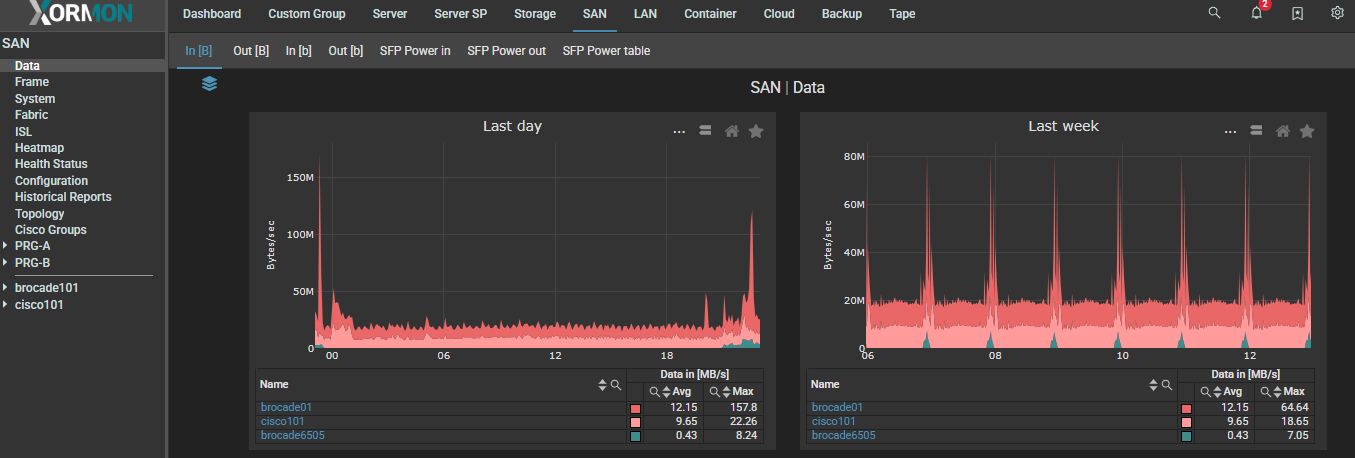 |
Topology
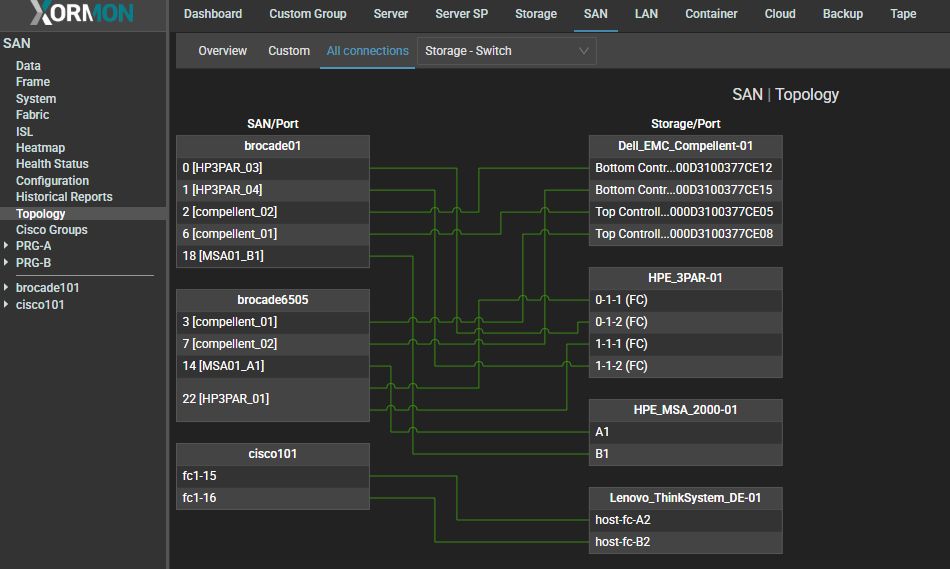 |
New to the terms used on this page? See the glossary entries for BB credits and SFP optical power.
Last updated: